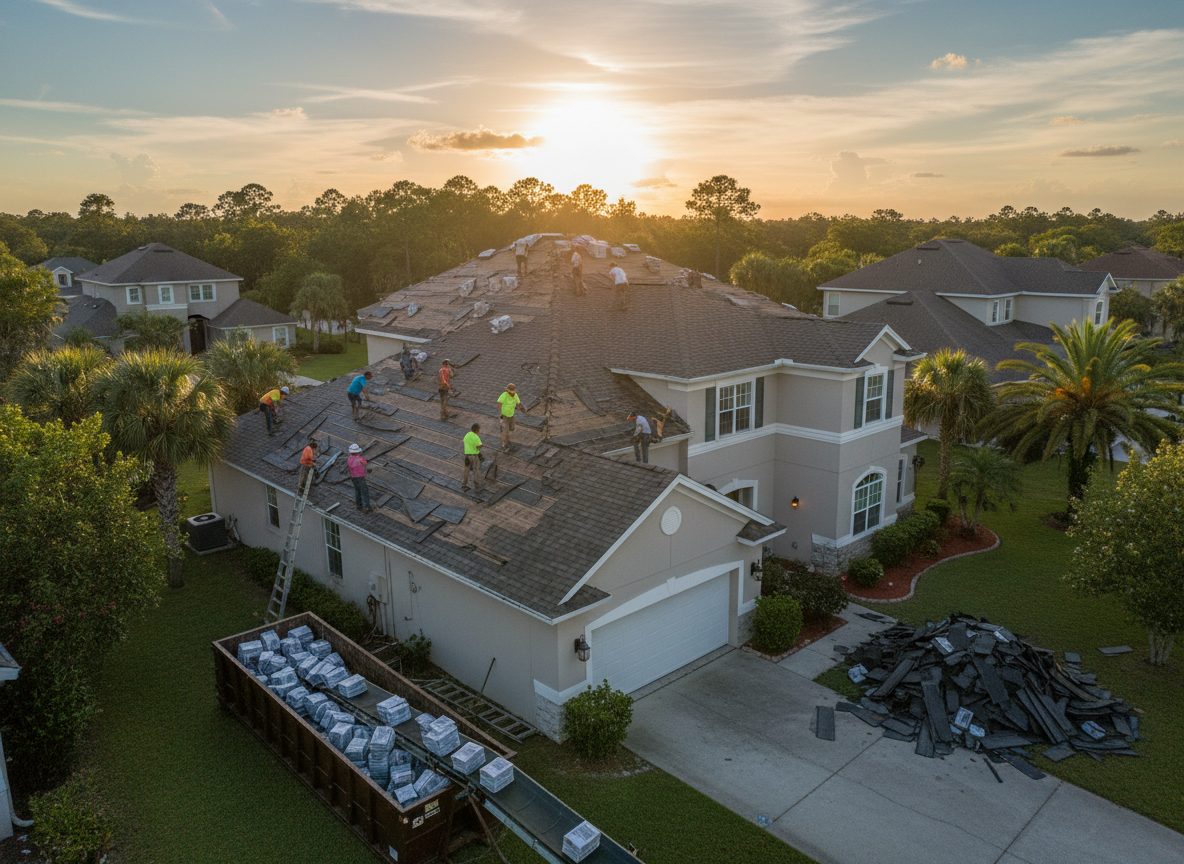
Sometimes the push to replace a Jacksonville roof comes from an insurance company, not the weather. A renewal notice asks for the roof's age, or an inspection flags worn shingles, and a roof that was only "getting older" now has a deadline. Sometimes it comes after a storm, when a repair estimate shows how much of the roof was hit. Our roof replacement in Jacksonville begins by answering the real question for your house. Does this roof need to come off now, can it be repaired safely, and what will each choice mean for your insurance and the building code?
Why Jacksonville Homeowners Talk to Us Before Replacing
Most roofing replacement pages in Jacksonville list materials and prices. Very few explain why the roof has to be replaced in the first place. In the competitor pages we reviewed, none explained Florida's 25 percent rule exemption for newer roofs, and none explained the 15-year roof age protection in Florida insurance law. Those two rules often decide whether you replace at all.
We tell you when you do not need a new roof. If a repair will hold and keeps you on the right side of the code and your insurer, you will hear that from us first.
You get an itemized estimate covering the full scope. Tear-off, decking repair, underlayment, flashing, the roof covering, permit and disposal are each listed separately. Section 489.147 of the Florida Statutes requires an itemized estimate before a repair authorization, and we apply the same standard to replacements.
We answer 24/7. Call (904) 467-6430 at any hour. Replacement questions often come up right after a storm or an insurance letter, and both tend to arrive at inconvenient times.
We treat the paperwork as part of the job. That means the permit, the final inspection and the record you need for a wind mitigation inspection afterwards.
Why Jacksonville Roof Replacement Decisions Should Not Drift
Three things make waiting expensive here.
The weather. NOAA's 1991 to 2020 normals for Jacksonville International Airport show 53.40 inches of rain a year, with June at 7.60 inches and September at 7.56. A roof that is failing in several places will be tested hard every summer.
The insurer. Under section 627.7011(5)(b) of the Florida Statutes, an insurer may not refuse to issue or renew a homeowner's policy solely because the roof is less than 15 years old. That protection does not cover roofs older than that. If your roof is approaching 15 years, the age question may come up at renewal.
The claim window. If the roof was damaged in a storm, section 627.70132 requires notice of an initial or reopened claim within 1 year after the date of loss. Deciding between repair and replacement too slowly can push that date close.
What You Can Verify About Us
We do not display licence numbers, review counts or certifications we cannot show you. Here is what you can confirm.
- Our phone and office. Call (904) 467-6430. Our office is at 2829 Edison Ave, Jacksonville, FL 32254.
- Our hours. We answer 24 hours a day, 7 days a week.
- Our estimates. You get a written, itemized estimate before any work is authorized.
- The statutes we cite. Every rule on this page comes from a section of the Florida Statutes you can read yourself. They are sections 553.844, 627.7011, 627.70132, 627.0629 and 489.147.
Florida requires roofing contractors to be licensed under Chapter 489. Before you sign a replacement contract with anyone, check the licence at myfloridalicense.com.
A Pre-2007 Code Roof After a Partial Storm Loss
This situation is specific to older Jacksonville homes, and none of the replacement pages we reviewed walks through it.
Take a house in Mandarin or on the Westside with a shingle roof installed before the 2007 Florida Building Code applied. A storm takes shingles off one slope. The repair looks simple, but two rules now meet.
The 25 percent rule. Section 553.844 gives roofs built, repaired or replaced under the 2007 Florida Building Code or later an exemption. On those roofs only the repaired portion must meet the current code. A roof built before that does not get the exemption. On an older roof, if the repair reaches 25 percent or more, more of the roof can be required to meet the current code than the damaged slope alone.
The age rule. If that same roof is over 15 years old, the protection in section 627.7011(5)(b) no longer applies. A patched older roof may still face questions from the insurer at renewal.
The decision. If the storm damage is well under 25 percent and the rest of the roof has real life left, a repair can be the right call. If the damage is near or over the line, or the roof is already being questioned by the insurer, a full permitted replacement may cost less over the next few years than a large repair followed by a replacement anyway. A new roof built to the current code also gives you a fresh starting point for a wind mitigation inspection.
We walk you through both numbers, the share of the roof affected and the roof's age, before you choose. If the damage is limited, see our roof repair in Jacksonville page.
What a Jacksonville Roof Replacement Involves
Tear-Off and Deck Inspection
Tear-off means removing the existing roof covering, underlayment and flashing down to the roof deck, the plywood or boards the roof is fastened to. Once the deck is exposed, soft, delaminated or rotted sections are visible and can be replaced. Laying a new roof over a weak deck shortens its life and can affect how well it holds in wind. A full tear-off also shows whether past leaks did more damage than the ceiling revealed. That changes the scope and the estimate, so we price deck repair as a separate line rather than burying it. It also clears away old layers, so the new roof is fastened directly to the deck as designed. When you compare bids, check whether each one includes full tear-off and how it prices replacement decking per sheet.
Underlayment and Secondary Water Resistance
Underlayment is the layer between the deck and the roof covering. It is the roof's second line of defense when wind lifts or removes shingles or tile. A secondary water barrier, such as sealed deck seams or a self-adhered membrane, is one of the features recorded on Florida's wind mitigation form, OIR-B1-1802. It keeps water out of the house when the outer layer is damaged, which is exactly what happens in a hurricane. Choosing it during a replacement is a decision about protection and possibly about insurance credits, since section 627.0629 requires insurers to offer discounts for qualifying mitigation features. It costs little compared with the roof covering itself. Ask every contractor bidding your roof what underlayment they use and whether it qualifies as a secondary water barrier.
Deck Attachment and Roof-to-Wall Connections
Deck attachment is how the plywood is nailed to the rafters or trusses: the nail type, size and spacing. Roof-to-wall connections are the straps or clips that tie the roof framing to the walls. Both are recorded on a wind mitigation inspection, because they decide whether a roof stays on in high wind. A replacement is often the least expensive time to improve deck attachment, because the deck is already exposed. That can affect both safety and premium, though any discount is set by your insurer, and we make no promise about it. Ask your contractor to state the deck nailing pattern in the written estimate. Then ask your wind mitigation inspector to review it after the roof is finished.
Permits and Final Inspection
A roof replacement in Jacksonville is permitted building work. For most addresses the permit is handled through the City of Jacksonville's Building Inspection Division. The permit means the work is inspected against the Florida Building Code, and it creates a public record of when the roof was replaced. Insurers, buyers and inspectors use that record to judge the roof's age and compliance. An unpermitted roof can cause trouble at sale or renewal, even when the work itself was good. Before work begins, ask whose name will be on the permit. The permit also confirms the roofing products used carry Florida product approval under section 553.842. Keep the permit number and final inspection date with your house records, because a wind mitigation inspector and your insurer may ask for them. After work is finished, ask for proof that the final inspection was passed.
Choosing Replacement Materials in Jacksonville
Shingle Roof Replacement
Architectural asphalt shingles are the usual like-for-like replacement for an existing shingle roof. They are lighter than tile, need no structural review when replacing shingles, and install quickly. Shingles are rated for wind by their manufacturer, and the rating is printed on the wrapper. Your permit office can tell you what your address requires. Compared with metal or tile, shingles have a lower upfront cost and a shorter expected service life. That trade-off matters if you plan to stay in the house for decades. Choosing the same material keeps the project simpler and the permit review straightforward. Roofing products used in Florida must carry state product approval under section 553.842. Ask to see the shingle's wind classification and Florida product approval number before it goes on your roof.
Metal Roof Replacement
Replacing a shingle roof with metal is a material upgrade. Standing seam panels with concealed fasteners are the more weather-tight option, and screw-down panels are the lower-cost one. Metal is light and sheds Jacksonville's summer rain quickly. Its seams and fasteners are where long-term maintenance happens. The commercial case for metal is a longer expected service life, which can make sense for owners who plan to stay. The trade-off is a higher upfront cost than shingles. Switching material changes the permit scope and the flashing details, so it should be decided before the estimate is final. Metal also reflects more sun than dark shingles, which can help attic heat in summer. Ask whether a proposed metal system has concealed or exposed fasteners and what that means for future maintenance.
Tile Roof Replacement
Concrete and clay tile are heavy and long-lived. On a tile roof the underlayment beneath the tiles usually wears out before the tiles do. A tile replacement can therefore be an underlayment replacement, with sound tiles removed, stored and reinstalled, and broken ones replaced with matching tile. That can save a large share of the material cost when the tiles are still in good condition. Switching from shingle to tile is a bigger decision, because the extra weight means the roof framing has to be designed or reviewed for it. Tile also needs correct wind attachment, by approved fasteners or adhesive, when it is relaid. Ask whether your existing tiles can be reused, and get the answer in the written estimate with a count of replacement tiles.
After the New Roof
Once the final inspection is passed, schedule a wind mitigation inspection. In Florida it is recorded on form OIR-B1-1802, and the current revision has been in effect since April 1, 2026. Under section 627.0629, insurers must offer actuarially reasonable discounts or credits for qualifying wind mitigation features. Any discount depends on your insurer and your home. The state's My Safe Florida Home program, run by the Florida Department of Financial Services, advertises free wind mitigation inspections and grants of up to $10,000 for approved upgrades. Read the current terms at mysafeflhome.com before you plan around one.
Plan Your Jacksonville Roof Replacement
If your insurer is asking about your roof, or a storm has left more damage than a repair can fix, call (904) 467-6430. We answer 24/7. You get a clear answer on repair versus replacement, the 25 percent rule and roof age explained for your house, and a written, itemized replacement estimate. Our office is at 2829 Edison Ave, Jacksonville, FL 32254.