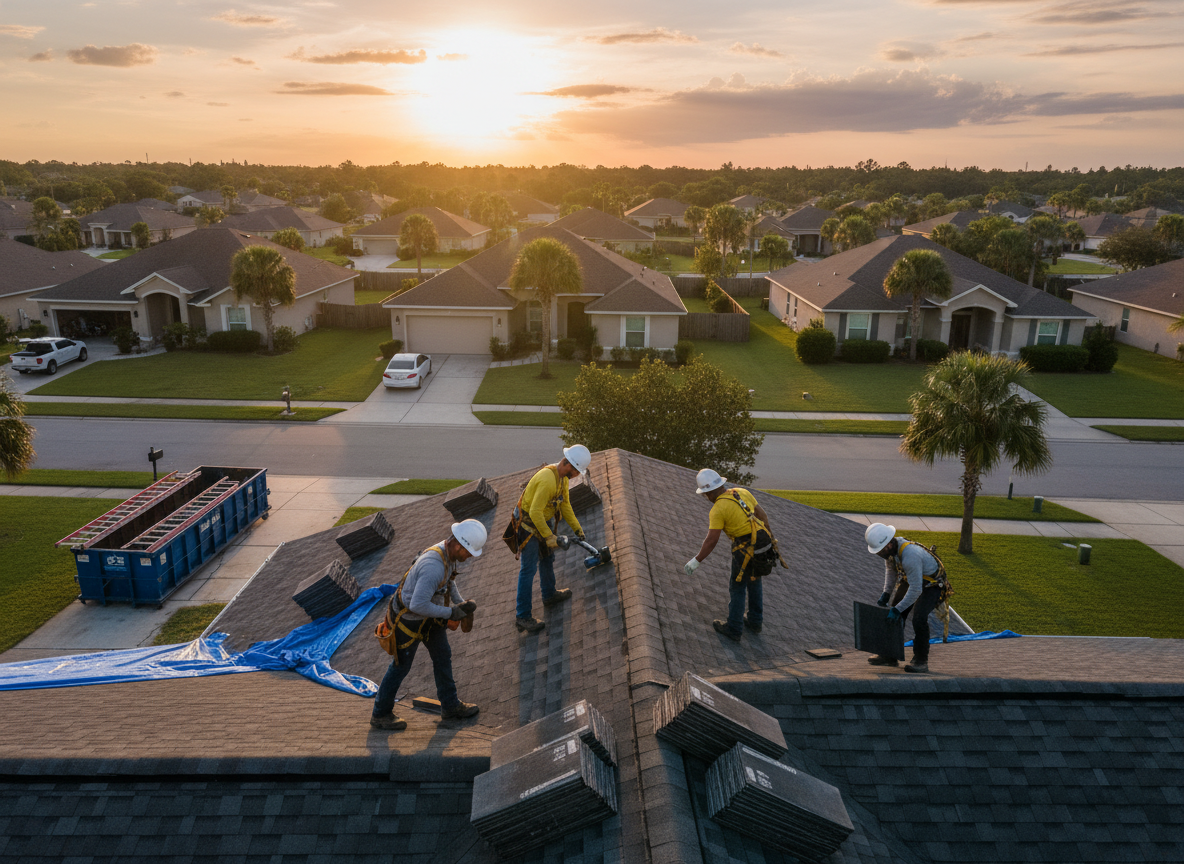
The most expensive roofing mistakes on a new Jacksonville build are made before anyone climbs a ladder. A tile roof chosen after the trusses were designed for shingles. A shingle without the wind rating your location needs. An addition whose new roof meets the old one at a joint nobody planned to flash. Our roof installation in Jacksonville FL starts at the plan stage, for new homes, room additions, garages and porches. Material, wind rating, connections and inspections are settled in writing while they are still cheap to change.
Why Builders and Owners Plan Roof Installation With Us
The roofing pages that rank for new roofs in Jacksonville are almost all replacement pages. In the five we reviewed, new construction got a line at most, additions were not mentioned, and none explained wind ratings, product approvals or inspection stages. If you are building, those are the details that decide whether the roof passes inspection and lasts.
We work from your plans. We review the roof design, the pitch, the structure it sits on, and how it connects to any existing roof before we price it.
You get an itemized estimate built on the plans. It covers deck, underlayment, flashing, roof covering, ventilation, trim and permit-related items, each listed separately. Section 489.147 of the Florida Statutes requires an itemized estimate before repair authorizations, and we hold new work to the same standard.
We answer 24/7. Call (904) 467-6430 at any hour. Builders keep long days, and weather-driven schedule changes in a Jacksonville summer do not wait for office hours.
You get the product details in writing. You will know exactly which product goes on the roof, its wind classification, and its Florida product approval number.
Why Roof Decisions Should Be Made Early in Jacksonville
Timing matters more for new roofs than for any other roofing work.
Structure is fixed early. Tile is far heavier than shingles or metal. If tile is decided after the framing is designed, the framing may need review or change. Decide the material before the truss design is final.
The weather window. NOAA's 1991 to 2020 normals for Jacksonville International Airport show 7.60 inches of rain in June, 6.77 in July, 6.88 in August and 7.56 in September. An open roof deck during those months needs to be dried in quickly. Scheduling dry-in around that pattern protects the framing and interior materials already in place.
Heat. The airport's summer normal high is 90.9°F. Ventilation, underlayment choice and roof color affect how hot the attic and the rooms below run. Those choices are easy to make at installation and hard to change later.
What You Can Check Before You Hire Us
We do not post licence numbers, review counts or manufacturer certifications we cannot show you. Here is what you can verify.
- Our contact details. Call (904) 467-6430. Our office is at 2829 Edison Ave, Jacksonville, FL 32254.
- Our hours. We answer 24 hours a day, 7 days a week.
- Our estimates. You get a written, itemized estimate tied to your plans.
- The product. Each product we propose is named with its wind classification and Florida product approval number, so you or your inspector can check it.
Florida requires roofing contractors to be licensed under Chapter 489 of the Florida Statutes. A certified contractor can work statewide, and a registered contractor only where they registered locally. Check any roofer, including us, at myfloridalicense.com before you sign.
Tying a New Addition Roof Into an Older Jacksonville Roof
Census Bureau American Community Survey data for 2024 puts the median year built for housing in Jacksonville at 1990. An owner adding a bedroom, a garage or an enclosed porch to a home of that age is likely joining brand-new roofing to a roof that is decades old. None of the installation pages we reviewed addressed it.
Two code eras on one house. The addition's roof is new work and must meet the current Florida Building Code. The existing roof was built to whatever code applied when it was installed. For a roof built before the 2007 Florida Building Code, section 553.844 matters later. If future storm repairs on that older roof reach 25 percent or more, they may require more of it to be brought up to code than a newer roof would.
The tie-in joint. Where the new roof meets the old one, there is a valley, a wall flashing or a cricket that has to shed water from both roofs. It is the most likely place for an addition to leak. It has to be designed with flashing that laps correctly under the existing roof covering, which usually means opening part of the old roof.
Matching or not. An exact match to an older shingle is often not available. Some owners choose a deliberate contrast, such as a metal roof on a porch, rather than a near-miss shingle color.
Planning both roofs together. If the existing roof is close to the end of its life, it can make sense to price a full roof replacement in Jacksonville alongside the addition, so both roofs share materials and one permit timeline. We show you both options in writing, and the choice is yours.
Building a New Roof in Jacksonville
New Construction Roofing
A new construction roof is installed on new framing as part of building a home. The sequence runs through deck sheathing, dry-in with underlayment, flashing at walls and penetrations, and then the finished roof covering, with inspections at the stages your permit requires. Getting the sequence right protects the framing and interior work from rain and avoids failed inspections that hold up the whole project. Decisions at this stage include deck nailing, underlayment type and ventilation. They all affect wind resistance and attic heat for the life of the house. Every product used should carry Florida product approval under section 553.842, which the permit inspector can check on site. If you are a builder or owner-builder, send us the roof plan and truss layout before the roof material is ordered.
Room Additions, Garages and Porches
An addition roof covers new space attached to an existing house. It may be a continuation of the main roof, a lower shed roof, or a separate gable. The value of planning it properly is a watertight joint and a roof line that looks intentional. The key decisions are pitch, because low pitches limit which materials can be used, how water from the main roof will be carried past the addition, and whether to match materials. A low-slope porch roof may need a membrane rather than shingles. The tie-in also changes how water flows off the existing roof, so gutters and downspouts may need to move too. Before your plans are final, mark where the new roof meets the old one and ask how that joint will be flashed.
Wind Ratings and Product Approval
Roof coverings sold for use in Florida carry a wind classification from the manufacturer and are listed under Florida's product approval system. Your designer or permit office can tell you what wind rating your address requires. The value is straightforward. A covering rated for the wind it will actually see is far more likely to stay on in a storm. Ratings also affect what a wind mitigation inspector can record later. Comparing products by their tested ratings is a sound way to choose between two shingles that look the same. Section 553.842 lists roofing as a product category that must be approved before use. Ask for the product approval number of every roofing product in your estimate, and check that it matches the wrapper on delivery day.
Ventilation and Attic Heat
Roof ventilation moves air through the attic, usually in at the soffits and out at the ridge. In Jacksonville's heat it carries away hot, humid air that would otherwise bake the underside of the deck and work its way into the living space. A balanced system helps the roof covering last and reduces the load on air conditioning. Getting it right at installation means planning intake and exhaust together, not adding vents afterwards. Ventilation also interacts with spray foam or sealed attics, which follow different rules. A sealed attic with spray foam, for example, should not have ridge and soffit vents added afterwards. Get the attic design confirmed before the roof deck goes on, because changing it later means opening the roof. Ask whether your attic is designed as vented or sealed, because the roof design has to match that choice.
Choosing a Roof Material for a Jacksonville Home
Shingle Roof Installation
Architectural asphalt shingles are the lightest and usually the lowest upfront cost of the three main options. Installation is fast, and they suit most framing without special review. They are rated for wind by the manufacturer. Their expected service life is shorter than metal or tile, which is the main trade-off for an owner planning to stay a long time. Shingles also need enough pitch to shed water. Very low-slope sections need a different covering. Lighter shingle colors reflect more sun, which can matter in the Jacksonville summer. Shingle lines differ, so check the rating on the exact product. Before you choose a color, ask about the shingle's wind classification and whether the color you want comes in that rated line.
Metal Roof Installation
Metal roofs on homes are usually standing seam panels with concealed fasteners, or screw-down panels with exposed fasteners. Metal is light, sheds heavy rain quickly, and has a long expected service life, which is the core of its value for owners who plan to stay. Concealed-fastener systems need less maintenance than exposed-fastener ones, whose rubber washers age in the sun. Metal also suits low-pitch porch and addition roofs better than shingles. The trade-off is a higher upfront cost and careful detailing at every edge and penetration. Metal also reflects more sun than dark shingles. Panel lengths and trim are often made to order, which affects scheduling. Ask any metal bid to state the panel type, metal gauge, fastener system and product approval number.
Tile Roof Installation
Concrete and clay tile roofs are heavy, long-lived and a strong match for Florida architectural styles. The tile itself lasts a long time, but the underlayment beneath it does the waterproofing and has a shorter life than the tile. The deciding factor for a new tile roof is structure. The framing must be designed for the weight, which is why the choice has to be made before trusses are ordered. Tile also needs correct attachment for wind, by approved fasteners or adhesive. Tile weight also affects the foundation and wall loads, which your designer should account for. Breakage during delivery and installation is normal, so order extra tile from the same production run for future repairs. If you want tile, tell your designer or truss supplier before the framing is engineered, and get that design in writing.
Permits and Inspections for New Roofs
New roof installation in Jacksonville is permitted building work. For most addresses the permit runs through the City of Jacksonville's Building Inspection Division. The permit sets the inspections the roof must pass, and it creates the public record insurers and future buyers rely on. After the roof is complete, a wind mitigation inspection on Florida's form OIR-B1-1802, current revision effective April 1, 2026, records its wind-resistant features. Under section 627.0629 of the Florida Statutes, insurers must offer discounts for qualifying features. The amount depends on your insurer, and we make no promise about savings.
Start Your Jacksonville Roof Installation
If you are building a new home or adding on in Jacksonville, call (904) 467-6430 before the roof material is ordered. We answer 24/7. You get a plan review, a material recommendation tied to your structure and location, and a written, itemized installation estimate with every product's wind rating and approval number. Our office is at 2829 Edison Ave, Jacksonville, FL 32254.