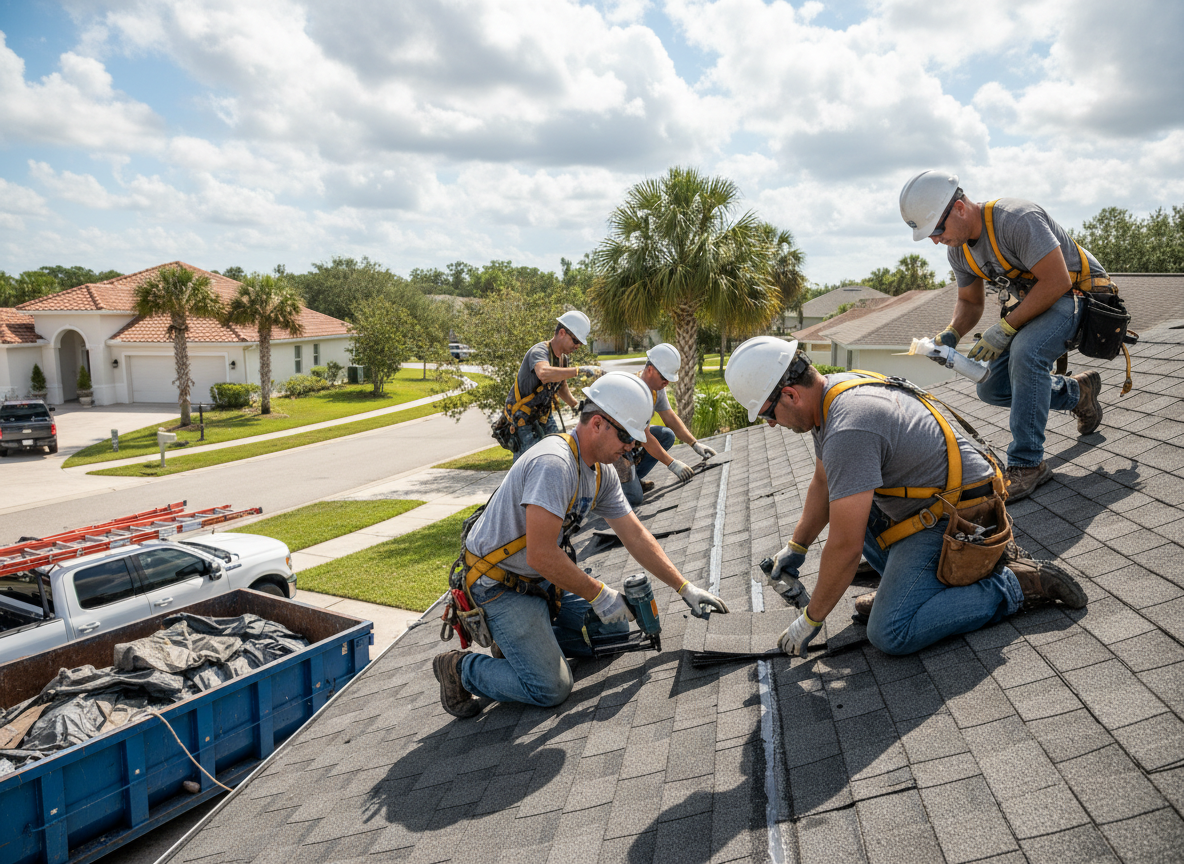
A ceiling stain in Jacksonville rarely sits right under the hole. Water that gets past a lifted shingle or a split pipe boot can run along the decking and rafters before it drips, so the stain over your hallway may start at a vent several feet away. Patch the wrong spot and the leak returns with the next afternoon storm. Our roof repair in Jacksonville FL starts with tracing the water to where it actually enters. We answer 24/7, and you get a written explanation of what failed before any repair begins.
Why Homeowners Choose Our Jacksonville Roof Repair Team
The Jacksonville repair pages we reviewed tend to lead with badges and leave the homeowner's real questions unanswered. Is this a claim or a maintenance repair? What is my deadline? Will a repair push me into a full replacement? We answer those questions first.
We answer around the clock. Call (904) 467-6430 at any hour, any day. Several local roofers post weekday-only hours, and a leak at 2 a.m. during a summer storm cannot wait for Monday.
You get an itemized estimate, as the law requires. Section 489.147 of the Florida Statutes prohibits a contractor from issuing a repair authorization without an itemized estimate. Ours separates leak control, permanent repair and anything optional, so you can decide line by line.
Repair comes first when repair is enough. We tell you plainly when a targeted repair will hold. When it will not, we tell you why, with the code rule or the condition that makes the difference.
There are no inducements and no policy interpretation. Florida law bars roofers from offering gifts or deductible waivers to get you to file a claim, and from interpreting your policy without a public adjuster licence. We describe the damage. Coverage is between you and your insurer.
Why a Jacksonville Roof Leak Should Not Wait
NOAA's 1991 to 2020 normals for Jacksonville International Airport show 53.40 inches of rain a year. June averages 7.60 inches, July 6.77, August 6.88 and September 7.56. A roof leak that starts in late spring has four of the wettest months in a row ahead of it.
Every rain that reaches the decking adds moisture to plywood, insulation and drywall. Those materials cost more to replace than the shingle or flashing that let the water in. Summer heat makes it worse. The airport's summer normal high is 90.9°F, so a wet attic stays warm and humid long after the rain stops.
There is also a legal clock. Under section 627.70132 of the Florida Statutes, notice of an initial or reopened claim must be given within 1 year after the date of loss, and a supplemental claim within 18 months. If storm damage caused the leak, the time you spend waiting counts against that window.
What We Can Show You Before You Hire Us
We do not publish review counts, licence numbers or manufacturer certifications we cannot put in front of you. Here is what you can check right now.
- Where to reach us. Our phone is (904) 467-6430 and our office is at 2829 Edison Ave, Jacksonville, FL 32254.
- When we answer. We are open 24 hours a day, 7 days a week.
- What you get in writing. You get an itemized estimate before any repair is authorized.
- The rules behind each answer. Every rule this page explains is from the Florida Statutes, and you can read the sections yourself. They are sections 489.147, 553.844, 627.70132 and 627.7011.
Florida requires roofing contractors to be licensed under Chapter 489. Check any roofer you are considering, us included, at myfloridalicense.com.
The Leak That Shows Up Days After the Storm
Some of the hardest Jacksonville leaks to diagnose leave no visible roof damage at all. Wind pushes rain sideways, under the edge of shingles, past the top of step flashing, or through a ridge vent. When the wind drops, the roof sheds normal rain without trouble. The stain only appears after the next wind-driven storm, or slowly over several days as wet insulation dries through the drywall.
This creates three problems no competitor page we reviewed addresses together.
The repair has to match the cause. A leak that only happens with wind from one direction usually points to flashing height, a vent baffle or sealant strips that let go. A spray-on patch over the stain will not fix it. We look at which slope faced the wind and test the details on that side.
The date of loss matters. Florida's 1-year notice period runs from the date of loss. For a hurricane or windstorm, the statute ties that to landfall or to the National Hurricane Center's verification of the storm, not the day you noticed the stain. Write down which storm came through before the stain appeared.
A temporary fix is still worth doing. Even before the cause is confirmed, covering the suspect slope stops new water from getting in. Keep photos and receipts for whatever you spend on it.
Roof Leak Repair in Jacksonville
Roof leak repair is the core of our repair work. These are the parts of a roof where leaks start and what each repair involves.
Finding the Leak Source
Leak tracing means following water from the stain back to the point where it enters the roof. We start in the attic where it is safe to do so, then move to the matching area on the roof surface. The value is that you pay once. A patch over the wrong spot costs a second visit and more ruined drywall. Tracing tells you whether you are dealing with one failed detail or a pattern across the roof, which is what decides between a repair and a bigger conversation. Before we arrive, note when the drip appears. Write down whether it shows only during heavy rain, only with wind, or hours after the rain stops. That timing points straight at the likely cause.
Flashing at Walls and Chimneys
Flashing is the metal that turns water away where a roof meets a wall, a chimney, a dormer or a change in slope. It is layered so each piece sheds onto the one below. When flashing lifts, rusts or was installed without enough overlap, water runs behind it and into the framing. Repairing flashing correctly usually costs far less than the rot it prevents in sheathing and wall studs. It also tells you whether the original installation was sound, which affects whether the rest of the roof can be trusted. Chimneys in particular need flashing that steps with the shingles and a counter-flashing cut into the masonry. Look at the point where your roof meets a second-story wall. Caulk smeared over the metal there is a sign someone has already tried a quick fix.
Pipe Boots and Roof Vents
Every plumbing vent, exhaust fan and attic vent is a hole in the roof sealed by a boot, collar or flange. Rubber pipe boots crack in strong sun, and flanges loosen when shingles around them lift in wind. These are among the simplest leaks to fix and among the easiest to miss. Fixing one is a low-cost repair that keeps water off the ceiling directly below. It also helps decide whether the rest of the roof needs attention, because if one boot has failed, the others are the same age. From the ground with binoculars, look at each pipe that comes through your roof. A replacement boot costs little, and it is a sensible add-on to any other repair visit. A boot that looks split or has pulled away from the pipe needs replacing.
Valleys
A valley is the channel where two roof slopes meet, and it carries more water than any other part of the roof. Shingle valleys can be woven, cut or lined with metal. Leaves and pine straw collect in them and hold water against the shingles. A failing valley can leak across a large area of ceiling because so much water passes through it. Repairing it is worth doing early, before the decking under it softens. The condition of your valleys also helps decide repair versus replacement, since a valley that has worn through often means the surrounding shingles are near the same point. Clear leaves and pine straw out of valleys after storms, and look for exposed or curling material in the channel.
Emergency Roof Repair and Tarping in Jacksonville
When water is coming in now, the first job is to stop more water from getting in. The permanent repair comes after that.
Emergency Tarping
An emergency tarp is a temporary waterproof cover fastened over the damaged area until the permanent repair can be made. Done correctly, it is anchored to sound framing, extends over the ridge, and keeps water from running underneath at the edges. A good tarp limits interior damage for days or weeks while the permanent repair is planned, priced and, where relevant, seen by an adjuster. Reasonable steps to protect the home from further damage are part of most policies, so check yours. A tarp also lets you choose a permanent repair without rushing. Do not climb a wet roof to tarp it yourself. A tarp nailed straight through the shingles can add holes, so how it is fastened matters. Call (904) 467-6430, then photograph the interior damage while you wait.
What Happens on an After-Hours Call
An emergency call follows a clear sequence. First we ask where the water is appearing and whether it is near electrical fixtures, which is a reason to switch off that circuit at the panel. Then we stop the water from the roof side, with a tarp or a temporary seal depending on the damage. The value is that the night ends with the water stopped and a record of what was done. The next decision is about the permanent repair, and you make it in daylight with a written, itemized estimate. If the leak is near a light fixture or outlet, turn off that breaker before anything else. Then put a bucket under the drip and move valuables out of the room.
Storm Damage Roof Repair in Jacksonville
Jacksonville's storm record shows how wind damage happens here. During Hurricane Helene in 2024, the National Weather Service recorded a 72 mph gust at Jacksonville International Airport, shingles blown off homes in the Bainebridge neighborhood off Pecan Park Road, and total roof destruction where trees fell on homes in the mid-Westside and Arlington Hills.
Wind and Hurricane Damage
Wind damage starts at the edges. Gusts lift shingle tabs, break the sealant strip that holds them down, and creased or missing shingles follow. Ridge caps, rake edges and corners take the most force. Hurricane winds can also drive debris into the roof or bring down limbs. Finding wind damage early matters because a shingle that is lifted but still in place lets water in during the next storm while looking almost normal from the ground. The inspection also helps decide whether the damage is spot repair or wide enough to raise the 25% question. After any strong storm, look along the roof edges and ridge for missing pieces. Check for shingle fragments in the yard and granules in the gutter outflow.
Documenting Storm Damage
Documentation is the record that ties the damage to the storm and the date. It includes dated photos of the roof, attic and interior, the storm name and date, and receipts for temporary protection. Insurers decide claims on evidence, and thin evidence means a slower claim. Good documentation supports whatever decision you make, whether that is filing, not filing, or fixing it out of pocket. Florida's 1-year notice window for initial claims under section 627.70132 makes this time-sensitive. Before anything is repaired, photograph every stained ceiling and wet area, and save the photos with their original dates. Keep a simple list of what you spent and when, alongside the photos. We can show you the roof-side damage we find, but the record is yours to keep.
Insurance Claim Steps
A roof claim generally follows the same steps. You report the loss to your insurer, an adjuster inspects, the insurer issues a coverage decision and payment, and the repair is completed. Knowing the sequence keeps you from authorizing work your insurer has not seen, or waiting so long that you pass a deadline. Florida law limits what a roofer may do here. Under section 489.147, a contractor may not interpret your policy or adjust your claim without a public adjuster licence, and may not offer anything of value for filing. Our role is to describe and price the physical damage. Keep a log of every call, with the date, the person you spoke to and what was said. Call your insurer or agent to report the loss and ask what documents they need before repairs.
Actual Cash Value and Replacement Cost
Actual cash value, or ACV, is what the damaged roof was worth at the time of loss, after depreciation. Replacement cost value, or RCV, is what it costs to repair or replace it with new materials of the same kind. Under section 627.7011, when a dwelling is covered for replacement cost, the insurer first pays actual cash value minus the deductible. It then pays the remaining amounts needed for the repair as the work is performed. This matters because the first payment may not cover the whole job. It affects how you schedule the work and what records you keep. Read the declarations page of your policy to see which type of coverage you have and what your hurricane deductible is.
Shingle, Tile, Metal and Flat Roof Repair
Each roof type fails differently, so each needs its own repair.
Shingle Roof Repair
Asphalt shingle roofs are layered and self-sealing, and they protect the roof through their granules and adhesive strip. Shingle repair means replacing lifted, creased or missing shingles and resealing the surrounding tabs so the patch blends in and stays down. It costs a fraction of a reroof when damage is limited to an area. A careful repair also tells you whether the rest of the roof can still bond. If the old shingles crack when lifted, that is evidence for the repair versus replacement decision. A repair also restores the sealant bond at the edge of the patch, which is where wind gets underneath next time. Done well, it buys time to plan a replacement on your schedule rather than in an emergency. If you have spare bundles from your original roof in the garage, keep them. Matching shingles makes repairs blend much better.
Tile Roof Repair
Concrete and clay tile roofs shed water through the tiles and keep it out through the underlayment beneath them. A cracked tile is often less of a problem than worn underlayment under tiles that look fine. Tile repair means replacing broken tiles, resetting slipped ones, and inspecting the underlayment where leaks appear. Walking on tile breaks it, so the person on your roof needs to know where to step. Repair is the value-preserving choice when the underlayment is sound. When it is not, the real decision is underlayment replacement, which we explain in writing. Matching tile profiles and colors can take time, so a temporary cover may come first. Do not walk on a tile roof to look for damage. Inspect from a ladder at the edge, or call us to look.
Metal Roof Repair
Metal roofs are standing seam or screw-down panels. Leaks usually start at fasteners, seams, or flashing trim rather than the panels themselves. Exposed-fastener roofs depend on rubber washers that age in the sun and loosen as the metal expands and contracts in the heat. Repair means resealing or replacing fasteners, resealing seams, and refastening trim. That keeps a long-lived roof watertight for a small fraction of its replacement cost. It also tells you whether a loose panel is a one-off problem or a sign of wider fastener failure. Fastener repair is planned work, not an emergency, if it is caught early. Left alone, a leaking fastener can rust the panel around it and damage the deck below. Look for rust streaks running down from screw heads. They show where water has been sitting around a fastener.
Flat and Low-Slope Roof Repair
Flat and low-slope roofs on porches, additions and some older homes use membranes or coatings rather than overlapping shingles. Water drains slowly across them, so a small split or open seam lets ponding water through. Repair means patching or reseaming the membrane and correcting the spots where water collects. A sound membrane repair protects the room below at much lower cost than replacing the whole low-slope section. It also shows whether the drainage is part of the problem. If water still stands on the roof a day or two after rain, that is worth fixing at the same visit. Where a low-slope roof meets a pitched one, the joint needs the same attention as a valley. Check after the next rain for standing water that has not drained after a day.
Repair or Replace Under Florida's 25 Percent Rule
Section 553.844 of the Florida Statutes affects what happens when a large share of a roof section is repaired. For a roof built, repaired or replaced under the 2007 Florida Building Code or later, only the portion actually repaired or replaced must meet the current code, even if it reaches 25 percent or more. Older roofs do not get that exception. On those roofs, a large storm repair can require more of the roof to be brought up to code, which is when a roof replacement in Jacksonville may make more sense than repeated patching. We explain which side of that line your roof is on before you decide.
Call for Roof Repair in Jacksonville Tonight
If water is coming through your ceiling, or a storm has moved shingles, call (904) 467-6430. We answer 24 hours a day. You get the leak stopped, the true entry point traced, and a written, itemized estimate that separates emergency work from the permanent repair. Our office is at 2829 Edison Ave, Jacksonville, FL 32254.